Toolkit: How to Reduce Synthetic Fertilizer Use
Many farmers and ranchers are transitioning away from synthetic fertilizer, and for many reasons. The increased cost of urea and ammonium fertilizers, supply disruptions, and the growing demand for organic and sustainably grown products have many farmers questioning the need for expensive inputs – especially given the benefits of ecologically based production practices. In fact, the Rodale Institute’s decades-long Farming Systems Trial comparing organic and conventional farming practices has shown that, based on market pricing, “raising certified organic commodity crops is more profitable for farmers than raising the same crops conventionally” (Economics of Organic – Rodale Institute).
Reducing synthetic fertilizer use and adopting ecologically based practices to maintain and sustain soil fertility can save money, increase net profit, and manage risk. Soil-based approaches to fertility help cropland and pasture withstand and recover from stressors such as drought, flooding, pests, and disease through improved soil structure and tilth.
Featured Resources for Reducing Fertilizer Use
BIOLOGICAL NITROGEN FIXATION
In healthy soil, nitrogen becomes plant-available through the biological activity of soil organisms. But if the soil you are starting with is poor, and you are looking to increase nitrogen levels to help boost productivity, what is the best way to do this? Instead of using commercial nitrogen fertilizer, there is a renewable source of nitrogen that farmers have utilized for millennia: biological nitrogen fixation, where atmospheric nitrogen is transformed into plant-available forms in the soil. Biological nitrogen fixation is done primarily by bacteria in association with leguminous plants, but also by certain soil bacteria such as actinobacteria and cyanobacteria. Establishing or maintaining legumes in the pasture while providing good habitat for free-living, nitrogen-fixing bacteria is a cost-effective, long-term way to ensure pastures have sufficient nitrogen. Biological nitrogen fixation provides approximately 65% of the nitrogen used by crops and pastures globally and can be maximized by maintaining diverse plants and robust agricultural soils.
How to Regenerate Soils and Sustain Crop Productivity
The agricultural practices that help build healthy soil are those that increase soil aggregation, contribute organic matter, increase biodiversity, buffer soil temperature, and minimize soil erosion, compaction, and disturbance. The principles that should define our soil management practices include:
- Minimize soil disturbance to preserve soil structure, encourage aggregation, and keep carbon in the soil to feed microorganisms. We minimize disturbance by using tillage strategically and infrequently and reducing or eliminating synthetic fertilizers and pesticides.
- Maintain living roots in the soil for as much of the year as possible to feed soil microorganisms all year. Cover crops on non-cash crop fields and beds are an excellent way to keep living roots in the soil.
- By maintaining living roots and leaving residue on pastures after grazing, we are covering the soil with vegetation all year, forming an “armor” to protect it from loss of moisture and nutrients.
- Maintain species diversity in cropland and pastures. A variety of plant families and species results in increased soil microorganism activity and more robust nutrient cycling. This can be achieved with cover crop mixes, crop rotations, and the use of diverse perennial pastures
Farmers, from small-scale vegetable growers to large-scale corn and soybean producers, are successfully reducing or eliminating the use of synthetic fertilizers.
Growing Fertility at Three Springs Farm
Emily Oakley and Michael Appel co-own and operate Three Springs Farm, a diversified, certified-organic vegetable farm in eastern Oklahoma. They cultivate more than 40 different crops and more than 150 individual varieties on their small farm. Their goal is to maintain an operation that demonstrates the economic viability of small-scale farming while minimizing the use of external fertility inputs.
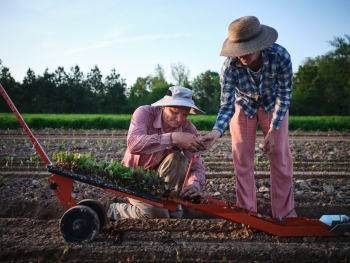
Emily Oakley and Michael Appel of Three Springs Farm in Oaks, Oklahoma. Photo: Jay Fram, www.jayfram.com
When Emily and Michael started, they needed to transform their worn-out soils into something alive and immediately planted a pea cover crop. Back then, they used chicken manure from CAFOs to add fertility, but they “wanted no part in being a dumping ground” for industrial waste. With that, chicken manure was out. Now, they grow about 90% of their fertility right on the farm with a diversified crop rotation and cover cropping sequence.
Three Springs Farm is laid out with three acres of vegetable crops and another three acres in cover crops at all times. Of the four fields on the farm, two are in cash crops and two are in fallow cover all year. A common field rotation on the farm starts with a spring cash crop followed by a summer cover crop. A fall/winter cover follows summer, with the whole next year in fallow covers. The next summer, the field will go into a summer cash crop, followed by a winter cover, a summer cover and winter cover the next year, then a different spring crop will start the rotation again.
Hear Emily explain her crop rotation and fertilizer reduction in a session from ATTRA’s 2023 Growing Hope Conference. Also, listen to Emily’s story “Growing Fertility on the Farm” on the Real Organic Project’s podcast. Finally, visit Mike and Emily’s farm website at threespringsfarm.com.
Growing Healthy Soils on a Large Scale with Rick Clark
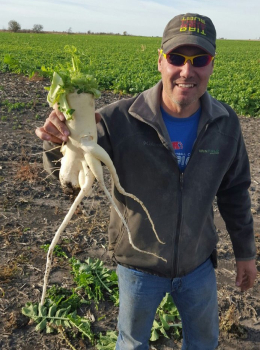
Farmer Rick Clark holding a tillage radish.
Reducing nitrogen use in commodity crops like corn most often results in a reduction in yield, though that doesn’t always equate to a reduction in profit.
Focusing efforts on the four soil health principles listed above can help maintain yields, but farmers must be prepared for several years of work before the soil is ready to sustain this kind of production. A reduction in the use of synthetic fertilizers should be made slowly as your soil health practices improve soil tilth and productivity.
Rick Clark has been farming commodity crops organically for 15 years. During that time he has focused on building soil health, especially with high biomass cover crops and diverse crop rotations. Over time his soils have improved, resulting in no nitrogen applications on corn for more than two years, and no phosphorus or potassium in over seven years. His low input system is based on soil health and overall profitability, not crop yield. Though he can at times maintain good yields in his organic no-till system, he is willing to sacrifice yield for soil health. Farmers can maintain a positive net income with a low unput system like Rick’s, even when yields are reduced.
For more information on the real-world effects of nitrogen reduction in corn, see the PFI article Can We Reduce N Rates to Corn and Improve ROI? – Practical Farmers of Iowa. Also see Rick Clark’s ATTRA Conference presentation Growing Healthy Soils on a Large Scale with Rick Clark, where he talks candidly about his system and how he was able to eliminate the use of fertilizers in commodity crops.
The Toolbox
The ATTRA Sustainable Agriculture program curates a library of trusted and practical resources to increase self-reliance and limit or eliminate the use of synthetics. Farmers and ranchers can use these resources to transition to production systems that are not reliant on synthetic fertilizers, usually over a three- to five-year period. The following publications are a good place to start learning how to implement practices like cover crops, green manures, alternative soil amendments, and sustainable grazing.
Cover crops
Cover crops provide a multitude of benefits, one of which can be biological nitrogen fixation if using legumes. Leguminous cover crops can accumulate from 40 to 200 pounds of nitrogen per acre. The amount of nitrogen available for a subsequent crop depends on the species of legume grown, the total biomass produced, and the percentage of nitrogen in the plant tissue.
- Overview of Cover Crops and Green Manures – ATTRA – Sustainable Agriculture
- Periodic Table of Cover Crops full-size – ATTRA – Sustainable Agriculture
- Cover Crop Options for Hot and Humid Areas – ATTRA – Sustainable Agriculture
- See also Green Cover – Boost Your Farm’s Resiliency with Cover Crops for excellent resources on cover cropping and other sustainable farming practices
Crop rotations
Crop rotation, i.e., planting a different crop on a particular piece of land each growing season, is a useful tool in preventing soil diseases, insect pests, weed problems, and building healthy soils. Plants exude a spectrum of photosynthates into the soil that are unique to each plant species, and these root exudates influence the soil microbial biodiversity, which, in turn, supports soil function and plant health.
- Tipsheet: Crop Rotation in Organic Farming Systems – ATTRA – Sustainable Agriculture
- Crop-Rotation-on-Organic-Farms.pdf (Page 27)
Alternative amendments
Producers may want to consider alternative sources of soil nutrients to fertilize their crops while building soil health. Manures, composts, fermented plant and fish “waste,” and biochar are among some alternatives that can support plant health in place of synthetic fertilizers.
- Ferments and Biochar: A Practical Guide to Utilizing Local Resources – ATTRA – Sustainable Agriculture
- Alternative Soil Amendments – ATTRA – Sustainable Agriculture
- Manures for Organic Crop Production – ATTRA – Sustainable Agriculture
- Tipsheet: Manure in Organic Production Systems – ATTRA – Sustainable Agriculture
- Composting: The Basics – ATTRA – Sustainable Agriculture
- How to Add Compost on Your Small Farm – ATTRA – Sustainable Agriculture
- Tipsheet: Compost – ATTRA – Sustainable Agriculture
- How to Brew Your Own Biofertilizers for Farms and Gardens – Video
Sustainable grazing
The impact of sustainable grazing is known to increase soil carbon and nitrogen stocks. As an animal grazes, it sends a signal to the plant to pump out sugars through its roots and into the surrounding soil, or rhizosphere. These root exudates (sugars developed by the plant through photosynthesis) are food sources for the microorganisms in the soil. The action of grazing jumpstarts the soil food web and increases nutrient cycling, making nitrogen, phosphorus, and carbon available to the growing plants.
- Building Healthy Pasture Soils – ATTRA – Sustainable Agriculture
- Nutrient Cycling in Pastures – ATTRA – Sustainable Agriculture
Ratcheting Down Commercial Nitrogen While Retaining Grass Production
In her informative article, Nitrogen: The Double-Edged Sword, Dr. Christine Jones (2014) outlines a path to reducing commercial nitrogen in pastures over a five-year period. She recommends a 20% reduction in the first year, followed by two years of additional 30% reduction, culminating with two years of minimal applications of 5 kg N/hectare (4.5 pounds per acre). At Montana Highland Lamb, the Scott family has roughly followed her advice for more than four years, and so far, it has proved successful. There has been no detectable drop in grass production, and in 2017 they did not apply any N fertilizer. The soil organic matter level is 5.5%.
Source: Nutrient Cycling in Pastures
Digging Deeper into the Science of Soil Fertility and Nutrient Cycling
Dr. Christine Jones’s articles on soil carbon, nitrogen, and reducing fertilizer use:
- Nitrogen: the double-edged sword
- Farming Profitably Within Environmental Limits
- Light Farming: Restoring carbon, organic nitrogen and biodiversity to agricultural soils
Change is Underway
Leading systems change is no small feat, especially within what seems like an intractable global food system. But change is underway, with a war on the other side of the world that is sending food and fertilizer costs skyrocketing, as well as from consumers who want better, healthier, and affordable products. Returning to agricultural self-reliance won’t happen overnight, and it will not be easy. But there are farmers successfully growing our food with this model of production right now. Farmers seeking self-reliance can replicate these methods across the patchwork quilt that is our agricultural landscape. Now is the time to embrace systems change and turn toward resilience by rebuilding soil health using practices that supply nitrogen naturally to grow the food and fiber we need.